

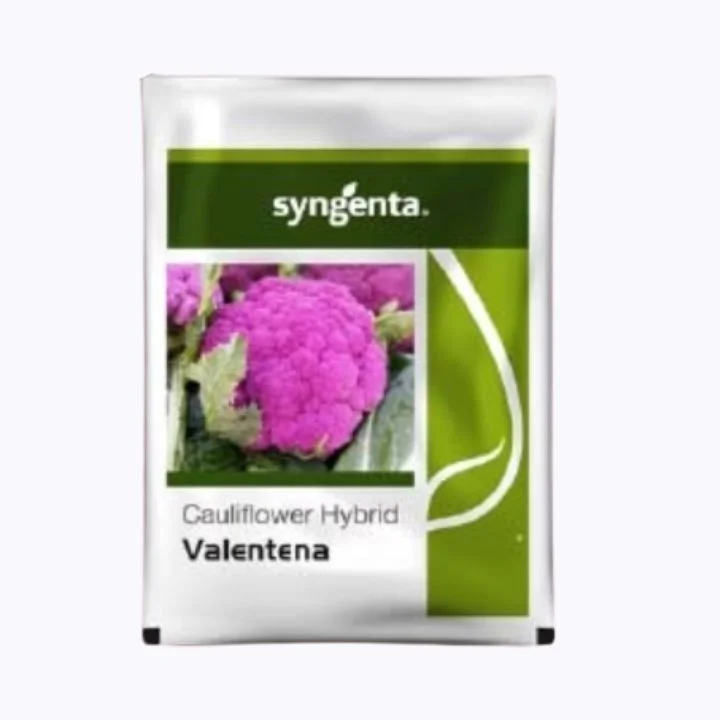
Description
Syngenta Valentena Hybrid Cauliflower Seeds
Product Overview: Syngenta Valentena is a premium purple cauliflower hybrid developed for farmers who seek high-quality produce with added nutritional value. Known for its rich anthocyanin content and exceptional self-covering ability, Valentena delivers both beauty and performance in the field. It produces compact, dome-shaped purple curds that are firm, uniform, and ideal for both fresh market and specialty segments. Best suited for cool and temperate regions, it offers reliable growth, excellent curd quality, and superior shelf life.
Product Specifications
| Brand | Syngenta |
| Product Name | Valentena Hybrid Cauliflower |
| Crop Type | Vegetable |
| Crop Name | Cauliflower (Brassica oleracea var. botrytis) |
| Plant Type | Temperate hybrid with strong plant vigor |
| Curd Color | Natural Purple (High Anthocyanin Content) |
| Curd Shape | Compact, Dome-shaped |
| Average Curd Weight | 1 – 2 kg (depending on growing conditions) |
| Maturity Period | 75 – 85 days after transplanting |
| Recommended Climate | Cool to Temperate |
| Self-Covering Ability | Excellent – natural leaf coverage protects curds from sunlight and discoloration |
Key Benefits
- Distinctive Purple Curds: Attractive color with rich anthocyanin content, offering antioxidant and health benefits.
- High Nutritional Value: Packed with essential nutrients, making it ideal for premium and health-conscious markets.
- Excellent Field Performance: Vigorous plant growth and strong self-covering ensure curd protection and uniform development.
- Adapted to Cool Climates: Performs consistently in temperate and moderately cool regions.
- High Market Value: Eye-catching appearance and strong shelf life make it ideal for fresh produce retailing.
Recommended Cultivation Practices
| Parameter | Recommendation |
|---|---|
| Seed Rate | 100 – 120 g per acre |
| Nursery Management | Raise seedlings in a well-drained nursery bed and transplant after 25–30 days. |
| Spacing | 45 × 45 cm or 60 × 45 cm, depending on soil fertility and climate. |
| Fertilization | Apply 10–12 tons FYM per hectare along with balanced NPK and micronutrients such as boron and calcium. |
| Irrigation | Maintain uniform moisture levels; avoid over-irrigation during curd formation. |
| Best Season | Rabi and early Kharif in cool and temperate regions. |



Reviews
There are no reviews yet.